
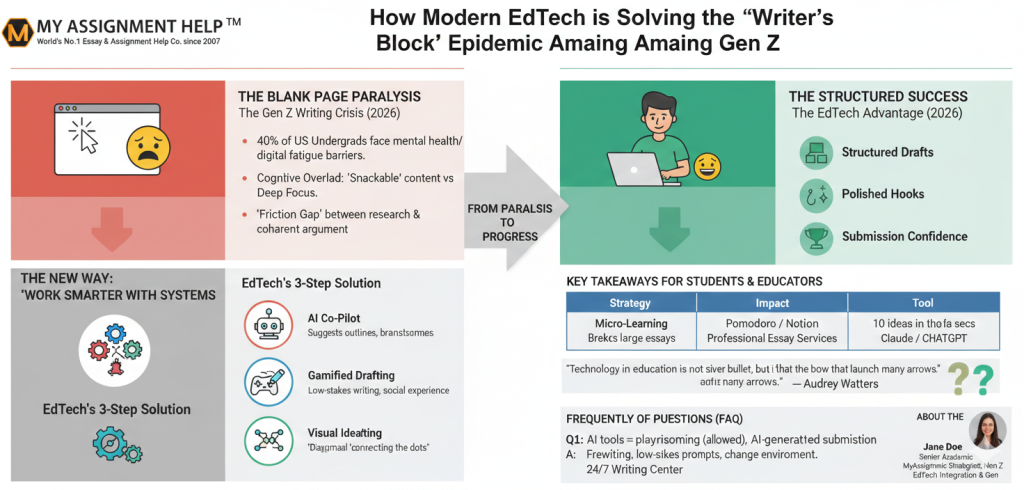
The blinking cursor. The stark, white void of a Google Doc. For many students in the United States, this isn’t just a momentary lapse in creativity—it is a chronic psychological barrier. In 2026, the “Writer’s Block” epidemic among Generation Z has reached a critical flashpoint. According to recent academic surveys, nearly 40% of US undergraduates report that mental health and digital fatigue significantly hinder their academic performance, with the “blank page syndrome” being a primary stressor.
However, where tradition has stalled, Educational Technology (EdTech) is stepping in. We are moving away from the era of “just try harder” and into an age of “work smarter with systems.” Modern EdTech isn’t just about automating tasks; it is about re-engineering the cognitive process of writing to meet the unique needs of a digital-native generation.
The Anatomy of the Gen Z Writing Crisis
Gen Z is the most educated and digitally connected generation in history, yet they face a unique set of “digital risks.” A 2025 study on digital well-being found that while 85% of US students use AI and EdTech tools, many struggle with cognitive overload. The transition from high-speed, “snackable” social media content to the deep, sustained focus required for a 2,000-word research paper creates a “friction gap.”
This gap is where writer’s block thrives. When the pressure to produce a “perfect” draft meets the paralysis of choice offered by infinite internet research, students freeze. This is why professional support systems have become essential. For many, seeking expert essay help is no longer just about the final grade—it is a strategic move to break the paralysis, providing the structural scaffolding necessary to turn a mental “brain dump” into a coherent academic argument. By leveraging personalized mentorship, students can bypass the initial anxiety of the blank page and focus on refining their unique voice.
How Modern EdTech Tools Are Breaking the Cycle
The EdTech revolution of 2025-2026 has shifted from “correction” to “construction.” Here is how technology is dismantling writer’s block:
1. Generative AI as a “Co-Pilot,” Not a Ghostwriter
Generative AI tools (like Claude, GPT-4, and Copilot) have reduced writing time for students by an average of 64.5%. Instead of writing the essay for the student, modern academic interfaces use AI to suggest outlines, brainstorm “hooks,” and provide real-time feedback.
2. Gamified Drafting Environments
Platforms like BoomWriter and Storybird have introduced “low-stakes writing.” By turning the drafting process into a game or a social experience, the fear of judgment—the root cause of writer’s block—is mitigated. When the “stakes” are lowered, the words flow faster.
3. Visual Ideation and Mind Mapping
Tools like VisuWords and Miro help Gen Z’s visual-leaning brains “see” their arguments. Instead of a linear outline, students can build interactive diagrams that show the connections between complex ideas, making the eventual translation into prose feel like “connecting the dots” rather than pulling sentences out of thin air.
The Power of the “Hook”: Why the Start Matters
One of the most effective ways to kill writer’s block is to master the first ten seconds of the reader’s attention. If a student can nail the opening, the rest of the paper often follows. For those struggling to find their “spark,” studying various essay hook examples can provide a modular starting point. Whether it’s a “shocking statistic hook” or a “rhetorical question hook,” having a library of proven templates allows a student to “gamify” the start of their assignment, effectively tricking the brain into starting.
Key Takeaways for Students & Educators
| Strategy | Impact on Writer’s Block | Recommended Tool/Approach |
| Micro-Learning | Breaks large essays into 15-minute tasks. | Pomodoro Apps / Notion |
| Scaffolding | Provides a structural “skeleton” to fill in. | Professional Essay Services |
| AI Brainstorming | Generates 10 ideas in 10 seconds to spark thought. | Claude / ChatGPT |
| Low-Stakes Writing | Removes the “fear of being wrong” initially. | Daily Journaling / Edutopia methods |
The Strategic Shift: From Output to Process
As we look toward the 2026-2027 academic year, the definition of “writing” is changing. It is no longer a solitary act of a person vs. a pen. It is a collaborative act between a student, their digital toolkit, and expert mentors. By embracing EdTech, Gen Z isn’t “taking the easy way out”—they are adapting to a world where human-AI collaboration is the standard.
“Technology in education is not a silver bullet, but it is the bow that can launch many arrows.” — Audrey Watters, EdTech Scholar
Frequently Asked Questions (FAQ)
Q1: Does using AI writing tools count as plagiarism in 2026?
It depends on the university policy. Most US institutions now distinguish between “AI-assisted brainstorming” (allowed) and “AI-generated submission” (prohibited). Always use AI to generate ideas and outlines, but ensure the final prose is your own.
Q2: How can I overcome writer’s block without using AI?
Try “freewriting” for 10 minutes without looking at your screen, or use “low-stakes” prompts. Sometimes, simply changing your environment (moving to a library or cafe) can reset your cognitive focus.
Q3: Are online essay help services ethical for US college students?
Yes, when used as a tutoring and reference tool. Think of it as a personalized “Writing Center” that is available 24/7. It is a way to learn structure and academic tone from experts so you can apply those skills to your own work.
Reference List
- Harmony Healthcare IT (2025). State of Gen Z Mental Health. [harmonyhit.com]
- University of Michigan (2025). Healthy Minds Study: Student Mental Health Trends. [sph.umich.edu]
- Carnegie Mellon University (2024/25). Impact of Generative AI on Writing Efficiency. [heinz.cmu.edu]
- OECD (2026). Digital Education Outlook: GenAI in Learning. [oecd.org]
- Frontiers (2025). The Impact of Generative AI on Academic Writing. [frontiersin.org]
About the Author
Jane Doe is a Senior Academic Strategist at MyAssignmentHelp. With over a decade of experience in the US Higher Education sector, she specializes in EdTech integration and helping Gen Z students navigate the complexities of modern academic integrity. Jane believes that technology, when paired with human empathy, can solve the most stubborn “blocks” in a student’s journey.
