
Electronics retail pricing has a habit of pulling teams into the same cycle: a competitor drops price, conversion starts wobbling, everyone rushes to match, and margin quietly disappears. It feels like the safest move in the moment, but over a quarter it can turn into a permanent habit of discounting, especially in categories where products age fast and shoppers compare prices obsessively.
So here is a more useful question than “What is the competitor charging?”
It is: “What price maximises our profit given everything we know right now?”
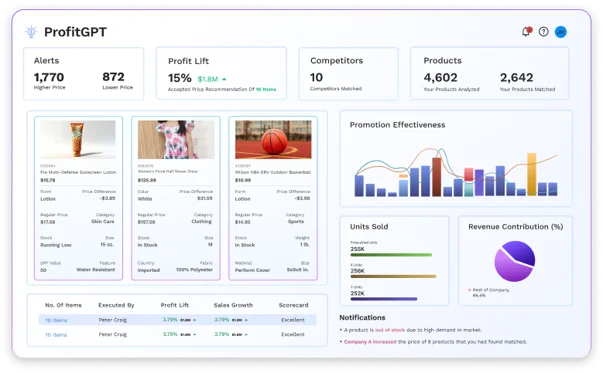
That is the mindset Hypersonix is built to support. It is not about replacing the pricing team or chasing every move in the market. It is about reducing manual effort, giving teams a cleaner view of the competitive landscape, and helping them take confident, AI-driven intelligent pricing actions with clear reasoning behind each recommendation.
Let’s make this simple.
Picture your weekly pricing routine. You are juggling a mix of hero SKUs, niche accessories, new launches, older models, and seasonal demand spikes. You are also dealing with noisy competitor signals like bundles that look cheaper but are not comparable, marketplace sellers that are not true peers, and product titles that do not match cleanly across retailers. This is where many pricing processes break down. If the data is messy, the decision becomes reactive.
Hypersonix addresses that by pairing two complementary capabilities.
Hypersonix’s Competitor AI is designed to track and organize competitor price and assortment signals on a cadence that fits your business, typically daily, weekly, or monthly, depending on how frequently you want market refreshes and how you operate internally. It focuses heavily on the quality of competitive matching so you are not comparing the wrong products. In electronics, that matters more than people admit. A “similar” product can hide meaningful differences in storage, model year, region, warranty, or bundle components. Competitor AI’s job is to help teams see a reliable competitive match so downstream decisions are grounded in clean comparisons.
Pricing AI then takes that competitive context and blends it with your other parameters such as costs, sales history, inventory position, market signals and demand behaviour. The point is not to chase the cheapest price. The point is to autonomously recommend prices that align with your goals, in order to maximize profits while staying competitive on key value items. Pricing AI uses elasticity modelling and configurable rules so teams can keep control over guardrails like minimum margin thresholds, channel-specific policies, or strategic price zones.
Now, let’s walk you through what it feels like in practice.
Start with a quick check:
If a competitor drops price on a high traffic SKU, what do you do first?
Most teams either match immediately or launch a frantic analysis across a handful of competitor tabs. Hypersonix helps you start in a calmer place: “Is this competitor move meaningful for us, or is it noise?”
In electronics, a competitor’s lower price might be driven by a short-term clearance, a bundle, a limited inventory position, or a model variant that is not truly comparable. When your competitive set is reliably matched, you can separate real threats from misleading signals and avoid unnecessary margin sacrifice.
Decide whether to respond, and how sharply
Let’s say it is a real move. Do we need to match, undercut, or hold?
This is where many retailers default to “match,” because it is easy to justify. Hypersonix pushes the decision toward “what action maximizes our outcome?” If you have strong availability and fast sell-through, you may not need to move much. If your conversion is slipping and the SKU is a known price perception driver, you might need a tighter response.
The key is that Pricing AI recommendations are meant to be explainable and actionable, so a category manager can see the logic, not just a number. This keeps humans in the loop while removing the slog of manual scenario-building.
Use markdowns with precision, not panic
Here is another interactive moment.
You have an older model laptop that is starting to age out, and you are holding too much stock. Do you mark down the whole subcategory, or just the SKUs that actually need help?
Blanket markdowns are the most common profit leak in electronics retail. A smarter path is to discount only where necessary, and only by the minimum amount needed to move inventory. Hypersonix supports that approach by helping teams identify which items are truly at risk and which items still have enough demand to hold price or take smaller steps down. That is how you reduce “panic markdowns” without slowing down execution.
Protect price when demand is in your favour
There is also the flip side that teams often miss. When demand is strong, why are you discounting at all?
Traditional rule-based systems and manual habits sometimes keep discounts running even when a product is already moving. Pricing AI helps highlight those moments where the business can protect price, preserve margin, and still maintain velocity. In a category where product lifecycle is short and suppliers change fast, those saved margin points matter.
Make pricing execution measurable
Pricing is not just deciding the number, it is ensuring it actually lands correctly across channels and systems, and that the impact is understood.
Hypersonix supports approval workflows and a tighter feedback loop through execution monitoring, so teams can quickly check and approve recommendations with one click, validate what changes were applied and evaluate outcomes like unit velocity, margin, and sales performance after price actions. This reduces the operational gap where teams make smart decisions but lose value due to inconsistent execution or slow detection of underperforming moves.
What this changes for an electronics retailer
Over time, the benefit is not just “better prices.” It is a different operating rhythm altogether.
Teams spend less time collecting competitor prices manually and arguing about whether a match is correct. They spend more time setting clear goals, defining guardrails, and choosing the right actions for the right products. Competitive pricing becomes structured rather than reactive. Promotions and markdowns become intentional rather than emotional.
With Hypersonix AI, teams turn reliable competitor tracking and explainable price recommendations into consistent actions that protect margin, improve sell-through, and keep pricing competitive without the constant scramble.
To learn more, visit: www.hypersonix.ai
