
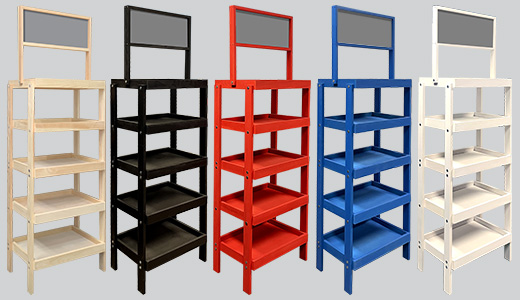
For small business owners in retail, trade, or service environments, how products are presented directly affects how customers engage with them. This is not about aesthetics alone. It is about workflow, spatial efficiency, and the practical reality of running a business where every square foot of floor or wall space contributes to revenue or wastes it. Choosing the wrong storage or presentation solution often means revisiting the decision within a year — at real cost in time, money, and lost customer attention.
The market for product presentation solutions has expanded considerably, and small businesses now have access to the same quality of fixtures once reserved for large retailers. But with more options comes the challenge of making a sound decision the first time. This guide addresses the key considerations that matter to small business owners: what types of solutions exist, how different configurations serve different business models, and what factors determine long-term value over initial price.
Understanding What Display Racks Actually Do for Your Business
display racks are structural fixtures used to organize, present, and make products accessible to customers or staff within a defined space. They are not simply shelving. The distinction matters because the purpose of a rack is to create order while directing attention — two functions that, when handled well, reduce customer confusion and increase purchase likelihood without requiring any additional effort from the business owner or staff. When you browse the range of available display racks from established suppliers, you begin to see how the category spans everything from rotating countertop units to freestanding gondolas designed for high-volume retail environments.
The functional value of a well-chosen rack extends beyond the point of sale. In stockrooms and back-of-house environments, the right rack reduces the time staff spend locating and retrieving items. In customer-facing areas, it communicates order and professionalism, which are qualities that smaller businesses often struggle to project against larger competitors with dedicated visual merchandising teams.
The Relationship Between Fixture Choice and Customer Behavior
Research in retail environment design, including work informed by the principles documented by the U.S. Small Business Administration on sales environment management, consistently shows that organized, accessible product presentation increases dwell time and reduces purchase hesitation. When customers can see, reach, and evaluate a product without friction, the barrier to purchase is lower.
This is particularly relevant for small businesses where staff availability is limited. A well-organized display rack effectively does some of the work that a sales associate might otherwise handle — it answers the question of what is available and where it is. Businesses that underinvest in presentation infrastructure often compensate with additional staff hours, which is a more expensive solution than the fixture itself.
The Main Categories of Display Racks and When to Use Each
Not all display racks serve the same operational purpose. The category includes freestanding floor units, wall-mounted systems, countertop units, rotating carousel racks, gridwall and slatwall panels, and specialty racks designed for specific product types such as clothing, books, or packaged goods. Each configuration solves a different spatial and merchandising problem, and choosing based on price alone without considering configuration often results in a poor fit.
Freestanding Floor Racks
Freestanding units offer the most flexibility because they can be repositioned without altering walls or infrastructure. For small businesses that reconfigure their floor plan seasonally or during promotional periods, this matters considerably. A floor rack also creates a visual anchor within a space, drawing customers toward a specific section or product grouping. The trade-off is that floor racks occupy square footage, which in a small retail or service environment is a meaningful cost.
The best use cases for freestanding racks are businesses with moderate-to-high product volume, open floor plans, and regular changes in inventory mix. Boutique clothing retailers, gift shops, and trade show vendors frequently rely on freestanding configurations for exactly these reasons.
Wall-Mounted and Panel Systems
Gridwall and slatwall panels attach to walls and allow products to be hung or shelved using interchangeable hooks and brackets. These systems are particularly effective in narrow or compact retail spaces where floor space is at a premium. Because the display surface is vertical, more product can be shown in less floor area.
The limitation of wall-mounted systems is their permanence. Installing panels requires drilling and, in leased spaces, may require landlord approval or create complications at the end of a lease. Businesses that own their location or have long-term occupancy commitments tend to make better use of wall-mounted systems. They are also effective in service environments such as hardware stores, salons, and specialty food retailers where products benefit from being organized by category along a defined wall section.
Countertop and Point-of-Sale Racks
Countertop racks are compact units designed to sit at or near the point of transaction. They are specifically used to promote impulse purchases or to highlight small, high-margin items. A business that has already invested in floor and wall fixtures should not overlook the countertop as a distinct merchandising zone. Customers standing at a register or service counter have a moment of attention that, when directed toward the right product, converts reliably.
Rotating countertop carousels are especially effective for businesses with a large number of small items — accessories, travel-sized products, greeting cards, or specialty snacks — because they expose more inventory in a compact footprint. Stationary countertop racks serve better when the product selection is limited and the goal is visibility rather than browsing.
Factors That Determine Long-Term Value
Small business owners frequently evaluate display solutions based on upfront cost, which is understandable given budget constraints. However, the total cost of a fixture over its useful life tells a more accurate story. A low-cost rack that requires replacement within eighteen months, cannot support the weight of denser inventory, or becomes visually dated quickly often costs more than a mid-range unit purchased once and used across multiple seasons.
Structural Durability and Weight Capacity
The structural integrity of a rack determines how reliably it performs over time and under real use conditions. Racks in customer-facing environments experience a significant amount of physical contact — products being removed and replaced, racks being shifted during cleaning, and occasional impacts from carts or foot traffic. A rack that wobbles, bends, or loses tension in its fittings creates both a safety concern and a poor customer impression.
Weight capacity is a related consideration that is often underestimated at the time of purchase. Businesses tend to buy a rack based on their current inventory weight, then add heavier or denser products as the business grows. A rack purchased to hold lightweight gifts will fail quickly if later used for packaged goods, hardware, or heavy folded textiles. Buying with some capacity margin is a straightforward way to extend the useful life of any fixture.
Modular Design and Adaptability
Racks with modular or reconfigurable components give small businesses a meaningful advantage. When a product line changes, or when a business expands its inventory categories, a modular system can be adjusted rather than replaced. Shelves can be repositioned, arms can be added or removed, and units can be combined to create larger displays or separated to serve different areas of a store.
This adaptability also supports seasonal merchandising. A business that sells different product categories at different times of year — holiday decorations, summer goods, or promotional bundles — benefits from fixtures that can be restructured rather than stored or discarded. Over a two-to-three year horizon, a modular rack system typically justifies its higher initial cost through avoided replacement purchases.
Portability for Trade Shows and Pop-Up Environments
A growing number of small businesses participate in trade shows, farmers markets, pop-up retail events, or mobile sales environments. These contexts require fixtures that are lightweight, quick to assemble, and compact for transport. Standard retail-grade floor racks are often impractical in these settings because they are too heavy or too large for standard vehicle transport.
Collapsible and portable display racks address this need directly. They are built for repeated assembly and disassembly without degrading in structural stability. For businesses that split their sales between a fixed location and event-based selling, having a dedicated set of portable fixtures prevents the unnecessary wear on permanent store fixtures and ensures the brand presents consistently across all selling contexts.
Matching Rack Type to Product Category
The physical characteristics of a product determine which rack configuration will support it most effectively. Hanging garments require racks with horizontal bars and sufficient clearance. Packaged goods benefit from shelved units with guardrails to prevent product from falling. Magazines, brochures, or flat items are best served by tiered display systems with angled pockets. Jewelry, eyewear, or small accessories require rotating or pegboard-style units that hold individual items securely.
Mismatching product type to rack design creates operational friction. Staff spend more time reordering product that falls, shifts, or becomes tangled. Customers are less able to browse independently. The result is a floor environment that feels disorganized even when the underlying inventory is well managed.
Purchasing Considerations for Small Business Budgets
Small businesses often face the tension between buying enough fixtures to fully merchandise a space and staying within a budget that leaves capital available for inventory and operations. The most practical approach is to prioritize customer-facing display racks first, since these directly affect sales, and invest in back-of-house storage solutions in a second phase.
Buying from suppliers who offer tiered options — entry-level, mid-range, and commercial-grade — within the same product category allows a business to test a configuration before committing to a full store’s worth of fixtures. Starting with one or two units, evaluating their performance under real conditions, and then expanding the purchase is a lower-risk approach than specifying an entire store layout without field experience.
Businesses should also account for the indirect costs associated with poor fixture choices: damaged product from inadequate support, safety incidents from unstable units, or staff time spent compensating for disorganized displays. These costs are real but rarely appear in a fixture purchasing decision until after the fact.
Concluding Thoughts
Display racks are one of the most consequential infrastructure decisions a small business makes, yet they are frequently treated as an afterthought in the broader context of store setup or event preparation. The right fixture reduces operational friction, projects professionalism, and supports customer behavior in ways that directly affect revenue without requiring ongoing investment or staff effort.
Small business owners in the United States operate in environments where every operational decision compounds over time. A fixture that works consistently, adapts to changing inventory, and holds up under daily use provides stable value across multiple business cycles. One that fails early forces a replacement decision at the worst possible time — usually during a growth phase when capital should be directed elsewhere.
The decision is worth taking seriously. Understanding your product type, selling environment, and long-term merchandising needs before purchasing will consistently produce better outcomes than selecting on price alone. The goal is a display solution that serves your business today and remains capable as your inventory and customer base grow.
