
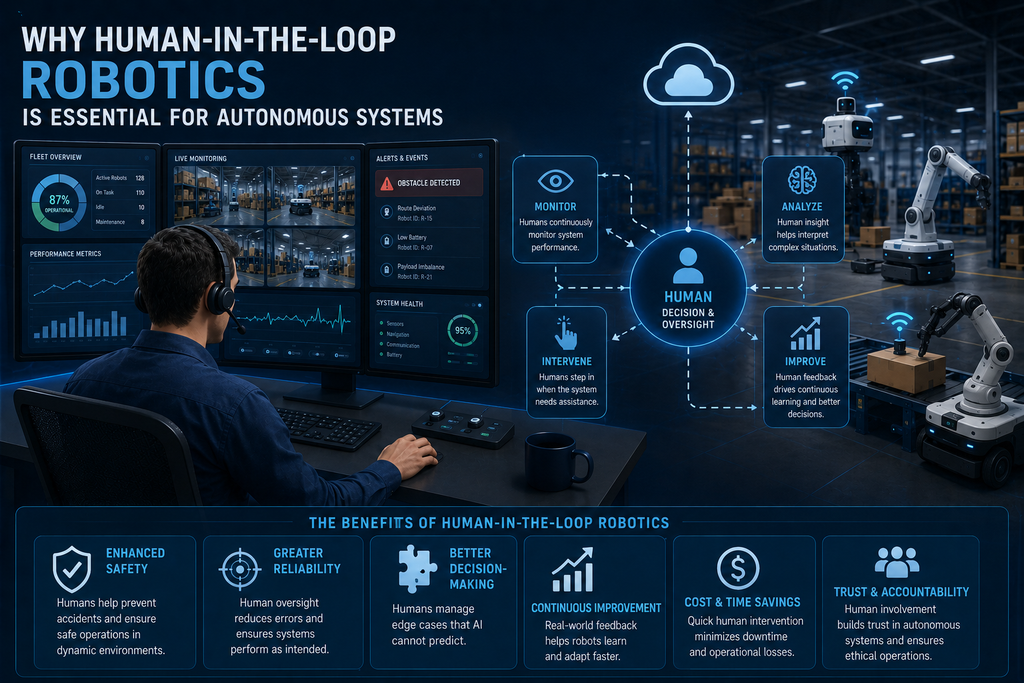
The rapid advancement of autonomous robotics is transforming industries such as logistics, manufacturing, healthcare, retail, security, and autonomous delivery. While modern robots can perform many tasks independently, they still encounter situations that require human judgment and intervention. This is where robot teleoperation and Human-in-the-Loop (HITL) robotics become essential. Together, they combine the speed and efficiency of automation with the adaptability and decision-making capabilities of skilled human operators.
By integrating remote human oversight into autonomous systems, businesses can improve reliability, enhance safety, and scale robotics deployments with confidence.
Understanding Robot Teleoperation and Human-in-the-Loop Robotics
Robot teleoperation allows trained operators to remotely monitor, control, and assist robots whenever autonomous systems encounter situations they cannot resolve independently. Human-in-the-Loop robotics extends this concept by keeping humans actively involved in the decision-making process while robots perform routine operations autonomously.
This collaborative approach enables robots to:
- Navigate complex environments
- Handle unexpected obstacles
- Respond to operational exceptions
- Continue performing with minimal downtime
The result is a more dependable and efficient robotics operation.
Why Human Oversight Remains Essential
Artificial intelligence continues to improve, but autonomous robots still face limitations when operating in unpredictable environments. Human operators provide the flexibility and judgment needed to address situations that fall outside programmed behaviors.
Human oversight helps businesses:
- Improve operational reliability
- Enhance robot decision-making
- Maintain service continuity
- Reduce system interruptions
- Increase overall deployment success
The combination of automation and human expertise creates a stronger operational framework.
Improving Safety and Reliability
Many commercial robots operate alongside employees, customers, or the general public. Continuous remote supervision helps identify potential issues before they become larger operational problems.
Robot teleoperation contributes to:
- Safer navigation
- Faster incident response
- Reduced collision risks
- Continuous operational monitoring
Reliable oversight helps organizations maintain high safety standards while maximizing robot performance.
Supporting Scalable Robotics Deployments
As businesses expand their robotic operations across multiple locations, maintaining on-site operators for every deployment becomes impractical. Centralized teleoperation allows experienced operators to supervise multiple robots from a single remote operations center.
Businesses can:
- Scale robot fleets efficiently
- Monitor multiple locations simultaneously
- Improve operational visibility
- Optimize workforce utilization
- Support business expansion
Remote support enables organizations to grow their automation programs without significantly increasing operational costs.
Increasing Operational Efficiency
Unexpected downtime can affect productivity and customer satisfaction. Human-in-the-loop robotics enables operators to quickly assist robots whenever unexpected situations occur, reducing interruptions and keeping workflows moving.
Benefits include:
- Faster issue resolution
- Higher robot availability
- Improved task completion rates
- Better fleet performance
Consistent operational support maximizes the value of robotics investments.
Supporting Multiple Industries
Robot teleoperation and human-in-the-loop robotics provide valuable support across a wide variety of commercial applications.
Common industries include:
- Warehouse automation
- Manufacturing
- Retail robotics
- Healthcare facilities
- Security patrol operations
- Autonomous delivery services
Each industry benefits from reliable remote monitoring and expert operational assistance.
The Value of Professional Robot Teleoperation Services
Many organizations rely on professional Robot Teleoperation services to provide continuous human oversight for autonomous systems. Experienced remote operators monitor robotic fleets, assist with navigation, respond to operational exceptions, and ensure robots continue operating safely and efficiently in real time.
Professional teleoperation services commonly include:
- Remote robot monitoring
- Human-in-the-loop operational support
- Navigation assistance
- Fleet management
- Incident response
- Performance monitoring
These services help businesses improve reliability while reducing downtime and operational risks.
Preparing for the Future of Intelligent Automation
As robotics technology continues to evolve, businesses will increasingly depend on a combination of artificial intelligence and human expertise. Human-in-the-loop robotics ensures autonomous systems remain adaptable, safe, and effective in real-world environments where unexpected situations are inevitable.
Organizations that integrate teleoperation into their automation strategy are better equipped to scale operations, improve customer experiences, and maximize the return on their robotics investments.
Conclusion
Robot teleoperation and Human-in-the-Loop robotics are essential components of modern autonomous systems. By leveraging professional Robot Teleoperation services, businesses can improve operational reliability, enhance safety, reduce downtime, and successfully manage growing robot fleets. Combining intelligent automation with skilled remote operators creates a scalable, efficient, and dependable solution for the future of commercial robotics.
