
Proviron is the brand name commonly associated with mesterolone, an orally active synthetic androgen. It belongs to the broader family of androgenic and anabolic steroids, although its pharmacological characteristics differ from several other compounds in this category.
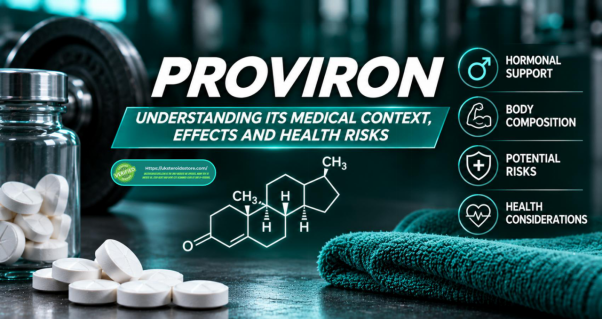
Mesterolone has been used in certain medical settings involving androgen deficiency and male reproductive health. However, it is also discussed in bodybuilding and performance-enhancement communities, where its effects are often described without sufficient attention to its limitations or potential health consequences.
Understanding Proviron requires looking beyond its reputation in fitness circles. Its hormonal activity, medical applications, possible adverse effects and limitations all matter when assessing its place in men’s health.
What Is Proviron (Mesterolone)?
Mesterolone is a synthetic androgen derived from dihydrotestosterone (DHT). It interacts with androgen receptors and produces effects associated with male sex hormones.
Proviron is commonly supplied as an oral tablet. One important characteristic is that mesterolone does not convert into oestrogen through aromatisation. This distinguishes it from testosterone, which can be converted into oestradiol through the aromatase enzyme.
Despite being classified within the anabolic-androgenic steroid family, mesterolone has relatively weak anabolic activity. Its effects are predominantly androgenic, meaning it is more closely associated with male sexual characteristics than significant increases in muscle tissue.
This distinction is important because its reputation in bodybuilding discussions can create expectations that do not accurately reflect its pharmacological profile.
Medical Uses of Mesterolone
Mesterolone has historically been prescribed in certain countries for medical conditions involving androgen deficiency in men. Its approved indications vary depending on national regulatory requirements and the product’s prescribing information.
Medical contexts associated with mesterolone include:
- Androgen deficiency: It has been used in selected cases involving insufficient androgen activity and related symptoms.
- Male reproductive health: Some prescribing information describes its use in specific forms of male infertility associated with hormonal or testicular conditions.
- Sperm-related parameters: Clinical product information reports potential improvements in sperm count and quality in selected patients.
These applications should not be interpreted as evidence that mesterolone is appropriate for every case of low testosterone, reduced libido or infertility.
Male reproductive health is influenced by several factors, including hormonal function, testicular health, general medical conditions and lifestyle. A proper diagnosis is necessary before considering any hormonal treatment.
How Does Proviron Work?
Mesterolone works primarily through androgen receptor activity. These receptors are present in different tissues and help regulate biological processes associated with male sexual development and hormonal function.
Its pharmacological characteristics include:
Androgen Receptor Activity
Mesterolone binds to androgen receptors, allowing it to produce androgenic effects in responsive tissues. These effects are associated with male sexual characteristics and other androgen-dependent processes.
No Aromatisation Into Oestrogen
Unlike testosterone, mesterolone does not undergo aromatisation into oestrogen. This is one reason it is discussed differently from many other androgenic compounds.
However, the absence of aromatisation does not mean that it eliminates oestrogen-related health concerns or makes hormonal use risk-free.
Limited Anabolic Activity
Although mesterolone has androgenic properties, its anabolic activity is relatively weak. It should not be considered equivalent to compounds primarily associated with substantial increases in muscle mass.
Understanding this difference helps separate its established pharmacological characteristics from exaggerated performance-related claims.
Proviron and Body Composition
Proviron is frequently mentioned in bodybuilding discussions because of claims involving muscle definition, physique conditioning and changes in body composition.
However, these claims require careful interpretation.
Mesterolone is not primarily recognised as a muscle-building compound. Its relatively weak anabolic activity means that claims of substantial muscle growth should not be treated as established medical benefits.
Body composition is influenced by several interconnected factors, including nutrition, physical activity, genetics, sleep and hormonal health.
There is also an important difference between a compound’s androgenic activity and its ability to produce measurable changes in muscle tissue. These properties should not be treated as interchangeable.
Potential Health Risks and Side Effects
Like other androgenic medications, mesterolone can produce unwanted effects. The likelihood and severity of these effects may depend on individual health, medical history and the circumstances of exposure.
Potential adverse effects described in product information include:
Skin and Hair Changes
Androgenic activity can contribute to acne and changes in hair growth. Some individuals may also experience accelerated hair loss, particularly where there is an underlying genetic susceptibility.
Changes in Sexual Function
Mesterolone may affect sexual function. Reported adverse effects include an increased frequency of erections and, in some cases, prolonged erections.
A persistent erection can become a medical emergency, particularly when it is painful or does not resolve.
Prostate Health
Androgenic activity is relevant to prostate health. Mesterolone should not be used by individuals with prostate cancer, according to the manufacturer’s prescribing information.
Prostate-related symptoms and medical history should be assessed by a healthcare professional before androgen treatment is considered.
Liver Considerations
Mesterolone differs chemically from certain orally administered anabolic steroids that are associated with greater liver toxicity. It is not accurate to assume that all oral androgenic compounds have identical liver-related risks.
Nevertheless, a comparatively different metabolic profile does not establish that a product is completely free from hepatic risk. Existing liver disease and other medications should be considered during medical assessment.
Cardiovascular and Metabolic Health
Androgenic and anabolic steroid misuse can affect cardiovascular and metabolic health. Potential concerns associated with non-medical steroid exposure include changes in cholesterol levels, blood pressure and cardiovascular function.
The evidence relating to broader anabolic steroid misuse should not be interpreted as proof that every reported complication occurs at the same frequency with mesterolone. Individual risks require clinical assessment.
Who Should Avoid Proviron?
Proviron is not appropriate for everyone.
The manufacturer’s prescribing information identifies important contraindications, including:
- Existing or previous liver tumours.
- Prostate cancer.
- Known hypersensitivity to mesterolone or other ingredients in the medicine.
It is intended for male patients and is not indicated for women.
People with existing medical conditions, unexplained hormonal symptoms or a history of reproductive health problems should seek medical advice before considering androgenic treatment.
It is particularly important not to use a hormonal medication simply because it is discussed as a physique-enhancement product.
Proviron in Bodybuilding: Medical Facts Versus Common Claims
Online discussions frequently associate Proviron with muscle definition, physique conditioning and hormonal balance.
However, these claims need to be separated from established medical information.
| Common claim | Medical context |
| Proviron builds significant muscle | Mesterolone has relatively weak anabolic activity |
| It cannot cause hormonal problems | Androgenic activity can still affect hormonal and reproductive health |
| It prevents all oestrogen-related issues | It does not aromatise, but this does not eliminate every hormonal concern |
| It is completely safe because it is oral | Oral administration does not make a medicine risk-free |
| It is suitable for every man with low testosterone | Treatment suitability depends on diagnosis and individual medical circumstances |
The key distinction is that a compound’s pharmacological properties do not automatically establish its suitability for non-medical performance enhancement.
Proviron Product Information
Mesterolone is available under different product names and pharmaceutical presentations, depending on the manufacturer and market.
For general product information, the UKSS catalogue includes a dedicated Proviron category.
A listed product is Hemi Pharma Proviron (Mesterolone) 25mg.
Product names, stated strengths and packaging should always be distinguished from independent verification of product authenticity, quality or regulatory approval. A product listing alone does not establish that a medicine is suitable for an individual’s medical needs.
Frequently Asked Questions
1. What is the active ingredient in Proviron?
The active ingredient in Proviron is mesterolone, a synthetic androgen derived from dihydrotestosterone.
2. Is Proviron an anabolic steroid?
Mesterolone belongs to the androgenic and anabolic steroid family. However, it has predominantly androgenic activity and relatively weak anabolic effects.
3. Does Proviron convert into oestrogen?
No. Mesterolone does not undergo aromatisation into oestrogen. However, this does not mean it is free from hormonal effects or potential adverse reactions.
4. Is Proviron used medically?
Yes. Mesterolone has been used in certain countries for selected medical conditions involving androgen deficiency and male reproductive health. Approved indications vary by market.
5. Can Proviron increase muscle mass?
Mesterolone has relatively weak anabolic activity and is not primarily recognised as a significant muscle-building compound. Claims about substantial muscle growth should be treated cautiously.
6. What are the potential side effects of Proviron?
Reported adverse effects include acne, hair loss, headaches, abdominal discomfort and increased or prolonged erections. Androgenic steroid misuse can also raise broader hormonal, cardiovascular and reproductive health concerns.
Conclusion
Proviron, or mesterolone, is an orally active synthetic androgen with a distinct pharmacological profile. Its medical history includes selected applications involving androgen deficiency and male reproductive health, while its relatively weak anabolic activity differentiates it from compounds commonly associated with muscle development.
Although it does not convert into oestrogen, this characteristic should not be confused with overall safety. Mesterolone can still produce adverse effects and is not suitable for every individual.
A clear understanding of its medical context, hormonal activity and potential health risks is essential. Any consideration of androgenic treatment should be based on an appropriate medical assessment rather than bodybuilding claims or online recommendations.
