
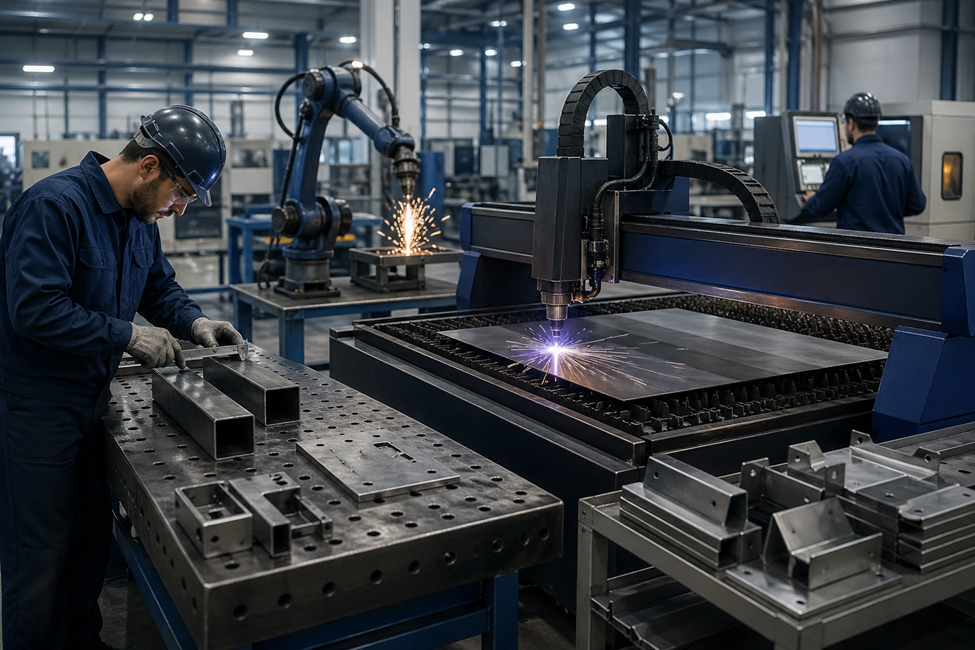
There’s an ongoing struggle in metal fabrication between accuracy versus speed.
If you’re too slow, you can’t be competitive with your pricing; but if you are too fast then the quality of your product will suffer. For a number of years, this balancing act relied on trained operators with many years of experience; however, the emergence of new technologies has drastically changed this scenario.
Companies that actively utilise new technologies used for cutting, forming and finishing their products have achieved efficiency rates that would seem far-fetched just a decade, or so, ago.
This article will discuss several areas where the metal fabrication industry is headed and provide insight as it pertains to your business operation.
The Rise of Automation on the Shop Floor
Metal fabrication, particularly in high-volume facilities, can utilize the advantages of using automated technologies today, as opposed to relying on manual repetitive work. Automation has permitted the introduction of automated material handling systems, robotic welding cells, and CNC bending equipment to greatly reduce the amount of manual repetitive work performed by operators and increased the consistency of finished products through dramatically reduced rates of defectives.
Not only does automation help with production speed, but it also minimises the amount of wasted material used in the fabrication process, reduces the possibility of human error on complicated cuts, and allows skilled operators to concentrate their time and attention on activities that truly require human decision-making. The various types of automation systems that are available today at various pricing and functionality levels, entry-level automation systems have recently become easier to find for small to mid-sized fabrication companies than ever before.
Advances in Cutting Technology
Laser cutting has brought about a huge increase in the efficiency and quality of finished products. Cutting using laser technology has allowed companies to create fine detail on very thin materials and achieve production speeds that are impossible with manual cutting techniques. However, when it comes to cutting thicker structural steel and heavy plate materials, the plasma cutter continues to be an important tool in the industrial sector.
The improvements made to modern industrial plasma cutting machines far surpass those of previous generations. Current plasma cutting machines have much tighter tolerances, increased production speeds, and produce better quality edges than older machines. Computer-aided software is available that allows the operator to nest the parts to be cut in order to make as efficient use of raw materials as possible.
Additionally, many of the more modern plasma cutting systems now include real-time monitoring and, therefore, give operators the ability to catch any potential defects before they become an expensive mistake.
Lean Principles Applied to Fabrication
Efficiency is not just about the technology being used, but also how you set up your shop and create material flow for your work processes. The principles of lean manufacturing (reducing wasted motion; waiting times between processes; having adequate consumables on the floor) directly affect throughput.
Job scheduling software that sequences jobs in order to reduce the amount of time needed to change materials and set-up tooling is becoming more widespread, even in smaller fabrication operations. When this type of software is used in conjunction with reliable equipment such as an industrial plasma cutting machine, it can dramatically enhance output.
Training and Retention Still Matter
At every stage of production, your machinery is only as efficient as its operators. By continuing to invest in continuous training for your workforce – including training on programming, maintenance, and quality inspection in addition to training for new machinery – you will benefit from greater returns. Skilled and experienced operators will identify issues early, produce jobs at a faster pace, and gain greater operational productivity from the various pieces of machinery.
The businesses that are experiencing the greatest gains in productivity have integrated smart technology with an experienced and well-trained workforce. Any individual component used separately would not provide the level of output available when combined.
